Mera Peak climbing: route, acclimatisation and permits for operators
Mera Peak climbing is a high but non-technical glacier climb in Solukhumbu, listed by the NMA at 6,470 m. The safest programmes approach slowly through the Hinku valley rather than crossing Zatrwa La straight after landing at Lukla, and allow spare days at Khare and Lukla. On 12 November 2026 the NMA royalty was USD 350 per person in spring and USD 175 in other seasons, plus Makalu Barun National Park entry.
| Mera Peak height (NMA listing) | 6,470 m, Khumbu Himal, Solukhumbu (checked 12 November 2026)Source: Nepal Mountaineering Association, NMA Peaks |
|---|---|
| NMA royalty, spring (March to May) | USD 350 per foreign climber (checked 12 November 2026)Source: NMA service charges for foreign climbers |
| NMA royalty, autumn, winter and summer | USD 175 per foreign climber (checked 12 November 2026)Source: NMA service charges for foreign climbers |
| Permit validity and guide rule | One month, extendable by two weeks; party must be accompanied by an NMA registered sirdar or guide; maximum 12 per groupSource: NMA rules and guidelines |
| Makalu Barun National Park entry | NPR 3,000 foreigners, NPR 1,500 SAARC nationals (brochure checked 12 November 2026; confirm before quoting)Source: DNPWC, Makalu Barun National Park brochure |
| Lukla airstrip elevation | About 2,860 mSource: CDC Yellow Book, Nepal |
| Ascent guidance above 3,000 m | No more than about 500 m gain in sleeping altitude per night, plus an extra night per 1,000 mSource: CDC Yellow Book, High Altitude Travel and Altitude Illness |
Mera Peak climbing suits clients who want a first summit above 6,000 m without the steep headwall of Island Peak. It is a long, remote trip with one big glacier day at the top, and many of the risks on Mera sit on the approach rather than on the climb itself. This guide sets out what agents and tour operators need to know before selling it: which summit and which figures to use, the two approach routes, how to build acclimatisation, the permits and government fees as checked on 12 November 2026, and how to package the trip.
Mera Peak in brief
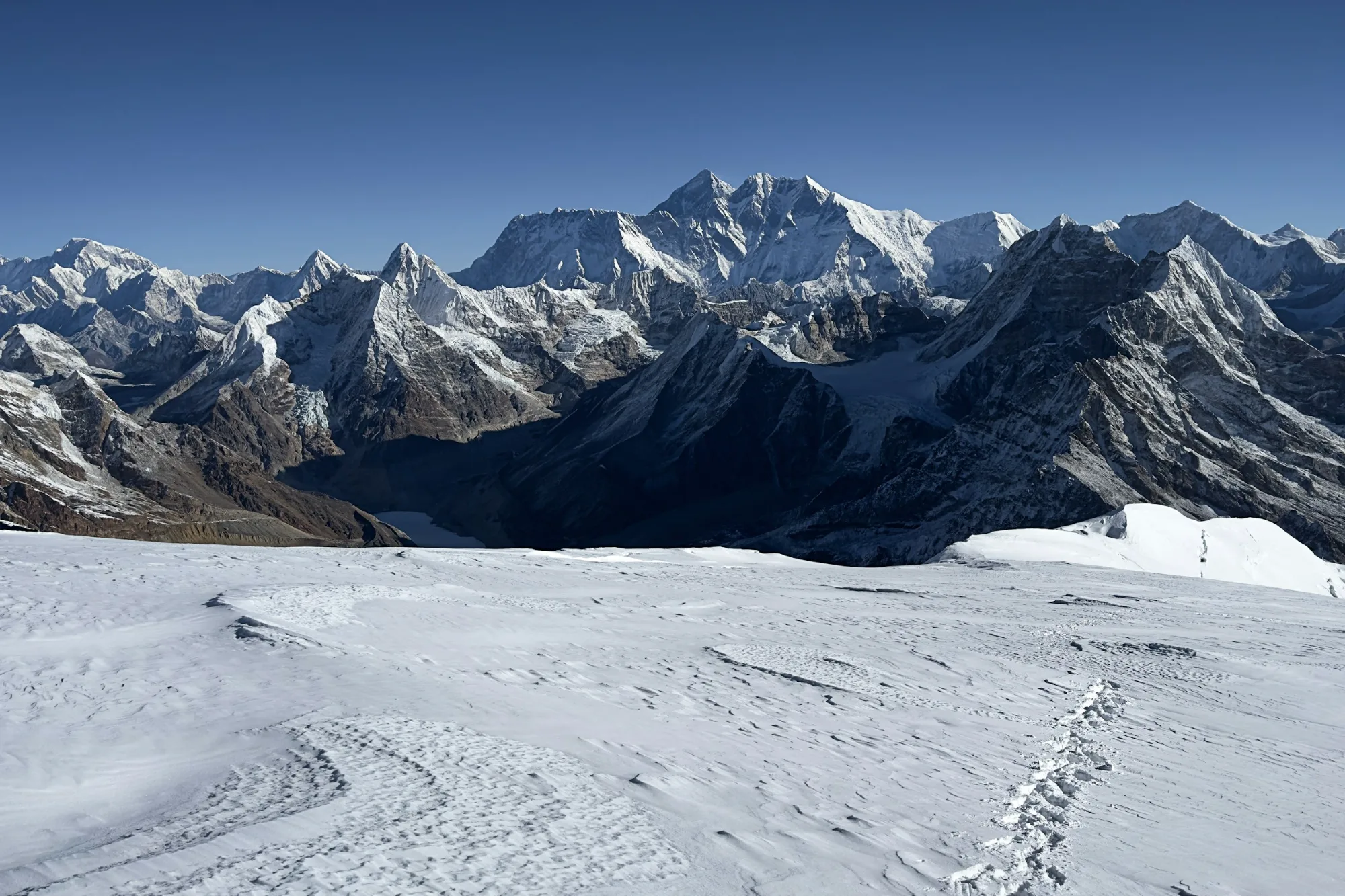
Mera stands in Solukhumbu district, south of Everest, above the Hinku and Hongu valleys. The Nepal Mountaineering Association (NMA), which issues the climbing permit, lists Mera Peak at 6,470 m in the Khumbu Himal range. You will also see 6,476 m in press reports and most brochures, and the Department of National Parks and Wildlife Conservation (DNPWC) material for Makalu Barun National Park gives a different, higher figure. For contracts and permit paperwork we suggest using the NMA figure, because that is the authority whose permit the client climbs on.
Mera is often marketed as Nepal's highest trekking peak. Be careful with that line: the current NMA fee schedule includes peaks listed higher than Mera, such as Chulu East and Singu Chuli. "One of the highest NMA peaks, and one of the least technical" is accurate and still sells.
The massif has more than one summit. Standard guided groups cross Mera La, climb the broad Mera glacier to a high camp, and on summit day continue up the glacier to the summit ridge, finishing with a short, steeper snow section where the guiding team normally fixes a line. It is a glacier climb rather than a rock or ice route. Clients need crampons, ice axe, harness and the ability to move roped together and use an ascender on a fixed rope. What makes Mera serious is altitude, cold, wind and the length of summit day, not technical difficulty. Confirm with your ground operator which summit the programme aims for, and write that into the itinerary so client expectations match.
Approach routes: the planning decision that matters most
There are two main ways into the upper Hinku valley from Lukla, and the choice affects safety and summit chances more than anything else in the programme.
The fast route: Lukla over Zatrwa La
The direct route leaves Lukla, which sits at about 2,860 m according to the CDC Yellow Book page on Nepal, and climbs steeply east to cross Zatrwa La before dropping into the Hinku valley towards Kothe, Thagnak and Khare. On paper it saves several days, which is why it appears in short, low-priced programmes. The problem is the altitude profile. The pass is far higher than Lukla and is reached within the first day or two after flying in, often with a cold, high overnight on the Lukla side. For a client who left sea level a few days earlier, that is a much bigger jump in sleeping altitude than standard medical guidance allows. The pass can also hold snow and ice after storms and in the colder months, and in poor visibility it is slow and disorienting.
We do not recommend crossing Zatrwa La on the way in unless the client is already acclimatised from an earlier trek. If a short programme is the only option, the client should understand that the risk of altitude illness is higher and the summit odds lower.
The longer route: via Paiya and Pangkongma into the Hinku valley
The alternative heads south from Lukla through Paiya and Pangkongma, then turns into the forested Hinku valley and follows it north to Kothe, Thagnak and Khare. It takes more days, the lodges are simpler, and there are some hard up and down stages, but the sleeping altitude rises gradually. Some programmes start from the road network lower in Solukhumbu instead of flying in, which also removes one Lukla flight from the risk list.
The design we usually recommend combines both: go in the long way and come out over Zatrwa La. After the summit the group is well acclimatised, so the pass becomes a quick exit to Lukla rather than a hazard.
| Factor | In via Zatrwa La | In via Paiya, Pangkongma and the Hinku valley |
|---|---|---|
| Days from Lukla to Khare | Fewer | Several more |
| Altitude profile | Very fast gain soon after landing | Gradual gain, easier to keep within ascent guidance |
| Weather exposure | High pass early in the trip, before clients are acclimatised | Lower, forested stages first |
| Lodges | Basic | Basic, fewer options on some stages |
| Best use | Exit route after the summit, or entry for clients already acclimatised | Default entry route for most clients and groups |
Flights to Lukla
Most Mera groups still fly in and out of Lukla. In autumn 2026, Kantipur reported that Manthali to Lukla flights had increased since late September, and that three airlines were preparing one weekly Kathmandu to Ramechhap flight each, subject to demand. Those weekly flights are unlikely to suit group schedules, so for clients this usually still means a very early road transfer from Kathmandu to Ramechhap before the mountain flight. Our Ramechhap airport and Lukla flights guide explains how this works and why buffer days are needed at both ends.
Altitude and acclimatisation
Khare is the last settlement below the glacier and the base for acclimatisation and skills training. Above it the route climbs to Mera La and onto the glacier, then on to high camp, from where summit day starts in the early hours. Every one of these steps is a significant gain, and none of them has a lodge or easy retreat once the group is on the ice.
The CDC Yellow Book chapter on high altitude travel gives a practical check for itinerary design: above 3,000 m, sleeping altitude should rise by no more than about 500 m per night, with an extra night for every 1,000 m gained. It also places travellers in a high risk category for acute mountain sickness when they gain more than 500 m a day above 3,000 m without extra acclimatisation nights, and notes illness rates approaching 50 per cent where destinations are reached rapidly by air above 3,400 m. A fast Zatrwa La approach followed by a quick push to Khare falls into that high risk category. Our article on altitude sickness and Nepal itinerary design covers the wider principles.
When we review a Mera itinerary, we look for:
- A gradual approach where daily gains stay close to the guidance, with rest nights added where village spacing forces larger jumps.
- At least two nights at Khare, with an acclimatisation walk and a skills session on crampons, fixed lines and ascenders.
- A spare summit day held at Khare or high camp, not spent earlier in the trip.
- An agreed turnaround time for summit day, set before the group leaves high camp.
- A clear descent plan for anyone who shows symptoms at high camp, with enough staff to escort them down without stopping the rest of the group.
Operator tip: Put the weather and acclimatisation contingency day on the mountain and a separate flight buffer day at the Lukla end. One spare day cannot do both jobs. If the group uses the mountain day, the flight buffer still protects the international departure.
Glacier, crevasses and summit day
The Mera glacier is broad and, in good conditions, not steep. It is still a glacier with crevasses, some of them hidden by snow, especially after fresh snowfall and on the descent in the softer afternoon snow. The group should move roped together, with a sensible ratio of climbing guides to clients and enough rope teams for slower members to turn back with a guide. Summit day is long, cold and exposed to wind, and clients descend tired to high camp or further.
Weather is the main variable. In October 2025, The Himalayan Times reported that a South Korean climber died, officials believed of hypothermia, after being stranded in snow while descending Mera in deteriorating weather; his Nepali guide was found alive at around 5,800 m, in a rescue coordinated by the NMA with IFMGA guides flown in from Kathmandu. The lesson for programme design is straightforward: build in time to wait out a storm, respect forecasts, and keep the turnaround rule.
Helicopter evacuation is the main rescue option from the upper Hinku valley, weather permitting, and the CDC notes that helicopter rescue in Nepal is usually limited to morning hours because of afternoon winds in the mountains. A client who falls ill late in the day may need to be helped down on foot or wait overnight, which is another reason to keep summit days on schedule. The CDC also notes that evacuation insurance policies generally require rescues to be arranged through the insurer, so the client's policy details must be with the ground team before departure. Policies must cover climbing to Mera's altitude, not only trekking. See our guides to Nepal trekking insurance requirements and how helicopter rescue works in Nepal.
Permits and fees for Mera Peak
All figures below were checked on 12 November 2026. Government fees change, so confirm the current figures with us before quoting a final price to clients.
NMA climbing permit. The NMA service charge schedule for foreign climbers lists Mera Peak at USD 350 per person in spring (March to May) and USD 175 per person in autumn (September to November), winter (December to February) and summer (June to August). The current schedule lists each peak individually and does not use the old group categories, so avoid quoting "Group A" or "Group B" fees.
Permit rules. The NMA rules and guidelines state that a climbing permit is valid for one month, with a possible extension of two weeks at extra cost, and that each party must be accompanied by a sirdar or guide registered with the NMA. All staff going above base camp must be insured for personal accidents, which your ground operator should arrange and be able to show you. The rules also cap a group at 12 people and require a nominated representative in Kathmandu, and fees already paid are not refunded if the climb does not go ahead. Larger groups therefore need to be planned as more than one party. Our article on the mandatory trekking guide rule covers the guide requirement on the trekking stages.
National park entry. DNPWC's Makalu Barun National Park brochure lists Mera among the park's major peaks and gives a park trekking route ending at Khare. It sets the entry fee at NPR 3,000 for foreigners and NPR 1,500 for SAARC nationals. The brochure dates from 2019, so we confirm the fee at the counter rate before each booking.
Local levies and deposits. Rural municipality fees and any garbage deposit rules change more often than national fees and depend on the exact route. We confirm these at the time of booking and include them in our net quote.
| Item | Issued by | Amount (checked 12 November 2026) | Notes |
|---|---|---|---|
| Mera Peak climbing permit, spring | NMA | USD 350 per person | March to May |
| Mera Peak climbing permit, autumn, winter, summer | NMA | USD 175 per person | September to February, June to August |
| Makalu Barun National Park entry | DNPWC | NPR 3,000 (foreigners), NPR 1,500 (SAARC) | Confirm current rate before quoting |
| Registered guide | NMA rule | Not a fee | Sirdar or guide registered with NMA must accompany the party |
| Local levies, garbage deposit | Local bodies, NMA | Confirm at booking | Depends on route and season |
Who Mera suits, and how it compares with Island Peak
Mera suits fit, patient trekkers who want to stand above 6,000 m and are comfortable with long days, simple lodges and cold nights, but who have little or no technical climbing background. Prior trekking at high altitude, ideally a pass or viewpoint well above 5,000 m, is a strong advantage. It is a poor fit for clients short of time, because the safe version of the trip is long.
Island Peak is the usual comparison. It is lower and is approached along the busier Everest Base Camp trail, but its upper section is steeper, with a headwall climbed on fixed ropes and a narrower summit ridge. Our Island Peak climbing operator guide covers it in the same format.
| Factor | Mera Peak | Island Peak (Imja Tse) |
|---|---|---|
| NMA listed height | 6,470 m | 6,160 m |
| Technical difficulty | Lower: glacier walk with a short steeper finish | Higher: steep headwall on fixed ropes |
| Approach | Remote Hinku valley, simpler lodges | Main Everest region trail, more lodges |
| Main risk | Altitude gain, cold and length of summit day | Technical section, crowding on the fixed lines in peak season |
| NMA royalty | USD 350 spring, USD 175 other seasons | USD 350 spring, USD 175 other seasons |
| Best client | Strong trekker, first 6,000 m peak | Trekker with some ropework confidence |
For travel agents: how to package it
What to include. A complete Mera package should cover the NMA permit, park entry and local levies, a registered climbing guide team as well as trekking staff, porters, lodges on the approach, tents, kitchen and fixed rope above Khare, a climbing gear check in Kathmandu with rental where needed, domestic flights or road transfers, and Kathmandu hotel nights at both ends. Ask clients for their insurance policy before you confirm, and check that it names climbing to this altitude and helicopter rescue.
Buffers. Build in at least one spare day on the mountain and at least one flight buffer day at Lukla, plus a free day in Kathmandu before the international flight. In autumn 2026 the Ramechhap routing adds a long road day each way, which should be priced and timed into the itinerary rather than treated as a surprise.
Who it suits. Sell Mera as a high, non-technical expedition for strong trekkers, not as a long trek with a short climb. Groups work well if fitness is reasonably even; mixed groups need enough guides for a slower rope team to turn back without ending the attempt for everyone. Remember the 12 person cap per party in the NMA rules when you plan larger departures.
Upsells. Popular additions include a pre-acclimatisation trek elsewhere in Nepal for clients who want to use the faster Zatrwa La approach, extra rest nights at Khare, private departures for small groups, an upgraded Kathmandu hotel, and guides in the client's own language arranged with advance notice. Our wider mountaineering in Nepal guide helps when clients ask what to climb next.
How we can help
Expert DMC Nepal is licensed by the Government of Nepal for travel, tour, trekking and mountaineering, and we are a member of the NMA and a TAAN member. We run trips with our own guides, transport and hotel contracts, and handle everything from FIT clients to large groups, standard to luxury, with guides in any language on request given advance notice. We can prepare Mera programmes with the longer approach, realistic buffers and current government fees confirmed at the time of booking. You can see our climbing and expedition programmes for the peaks we operate.
If you want a net quote or a draft Mera itinerary for your clients, become a partner and send us your enquiry.
Frequently asked questions
How high is Mera Peak?
The Nepal Mountaineering Association lists Mera Peak at 6,470 m, and 6,476 m is the figure most often quoted in press reports and brochures. We use the NMA figure on permits and contracts.
Is Mera Peak harder than Island Peak?
Mera is higher, longer and more remote, but technically easier: it is mostly a glacier walk with a short steeper finish, while Island Peak has a steep headwall climbed on fixed ropes. The main challenge on Mera is altitude, cold and the length of summit day.
How many days does it take to climb Mera Peak?
As a planning guide, a programme with the longer Hinku valley approach and proper buffer days usually needs around 16 to 20 days from Kathmandu back to Kathmandu. Shorter programmes exist but usually cross Zatrwa La early and cut acclimatisation.
Do clients need technical climbing experience for Mera?
No technical background is needed, but clients must be comfortable walking in crampons, moving roped together and using an ascender on a fixed line. A skills session at Khare covers this, and prior high altitude trekking is a strong advantage.
What permits are needed to climb Mera Peak?
Clients need an NMA climbing permit for Mera Peak and Makalu Barun National Park entry, and the party must be accompanied by an NMA registered guide. Local levies depend on the route, so we confirm them at booking.
When is the best season for Mera Peak?
Autumn and spring are the main climbing seasons. The NMA royalty is lower outside spring, but winter brings severe cold and snow on the passes, and the monsoon months bring cloud, rain and poor flying weather.
Sources
- NMA: Service charges for foreign climbers (per person, USD)
- NMA: NMA Peaks
- NMA: Rules and guidelines
- DNPWC: Makalu Barun National Park brochure
- CDC Yellow Book: High Altitude Travel and Altitude Illness
- CDC Yellow Book: Nepal
- The Himalayan Times: Body of Korean climber recovered, Nepali guide rescued from Mera Peak (6 October 2025)
- Kantipur: More Manthali to Lukla flights added (4 October 2026)