Nepal travel insurance for treks: what cover to require from clients
No Nepali rule we found requires a foreign trekker to hold travel insurance, but agents should make it a booking condition. The policy must cover trekking to the itinerary's highest point, helicopter evacuation and medical costs, and climbing cover for any trekking peak, because rescue is expensive and care outside Kathmandu and Pokhara is limited.
| Trekker insurance rule | None found: the NTB TIMS page asks for trekker, guide and route details but not insuranceSource: Nepal Tourism Board, TIMS Card |
|---|---|
| Integrated Tourism Bill | Passed the National Assembly in February 2026; in House of Representatives committee from July 2026; not law on the date checkedSource: The Kathmandu Post, 22 July 2026 |
| UK advice | Insurance should include cover for mountain rescue services and helicopter costsSource: GOV.UK, Nepal safety and security advice |
| US advice | Obtain emergency medical evacuation insurance; uninsured travellers must pay in cash before a medevacSource: US State Department, Nepal country information |
| Expedition staff cover | Minimum cover raised in January 2025 to NPR 2 million for high-altitude guides and NPR 1.5 million for base camp workersSource: The Kathmandu Post, 21 January 2025 |
| Thorong La | 5,416 mSource: Nepal Tourism Board, Annapurna region |
| Fake rescue case | 32 people charged at Kathmandu District Court in March 2026 in a scheme involving claims of more than USD 19.6 millionSource: The Kathmandu Post, 23 March 2026 |
Travel insurance is the document agents are most likely to treat as the client's business, and the one that causes the most trouble when it is wrong. In Nepal the problem is rarely that a client has no insurance at all. It is that the policy stops at an altitude below the trek's high point, excludes helicopter evacuation, or treats a trekking peak as mountaineering. This guide sets out what Nepali rules actually require, what the UK, US and Australian governments tell travellers, and the checklist we suggest agents use before confirming a trek or climb. We do not recommend insurers; the point is to know what the policy must cover.
Why insurance is a booking condition in Nepal
On the date checked, we found no Nepali rule that requires a foreign trekker to hold travel insurance. The Nepal Tourism Board's TIMS card page describes a registration form with details of trekkers, guides and routes, and does not ask for an insurance policy. A new Integrated Tourism Bill passed the National Assembly in February 2026. The House of Representatives sent it to committee in July 2026, where lawmakers registered amendments, and the House's International Relations and Tourism Committee was still discussing it in August 2026, as reported by the Kathmandu Post and Business 360. We found no later report that it has passed the House or become law.
The absence of a legal requirement does not make insurance optional in practice, for three reasons:
- Rescue has to be paid for. The US State Department tells travellers to obtain emergency medical evacuation insurance, says evacuations can cost tens of thousands of dollars, and warns that uninsured travellers will be expected to pay in cash before a medevac.
- Care outside the cities is limited. The UK FCDO describes healthcare as poor in most places outside the Kathmandu Valley and Pokhara, so a serious problem on a trek usually means a flight out.
- The agency carries the responsibility. Under the Department of Immigration's March 2026 rules allowing solo trekkers in restricted areas, with a licensed guide and through a registered agency, the facilitating agency is fully responsible for emergency rescue and logistical arrangements, as reported by the Kathmandu Post. On every trek, the ground operator is the one arranging the helicopter, and it needs to know that someone will pay for it.
For these reasons we make valid insurance, covering the itinerary's activities and altitude, a condition of every trek and climb we operate. Our briefing on Nepal travel safety and current advisories covers the wider risk picture you can share with clients.
The altitude limit trap
Many travel policies cover trekking only up to a stated altitude, and some limit it further unless an adventure or hazardous-activity add-on is bought. Smartraveller's advice is to check that the policy covers the altitude the traveller will reach and altitude sickness, and not to assume that travel insurance covers adventure or high-risk activities. The table below gives the high points of common itineraries and the ceiling we suggest agents look for, rounded up to leave a margin.
| Itinerary | High point | Published altitude | Ceiling to look for |
|---|---|---|---|
| Annapurna Base Camp | Base camp | 4,130 m (NTB) | 4,500 m or more |
| Annapurna Circuit | Thorong La | 5,416 m (NTB) | 6,000 m |
| Manaslu Circuit | Larkya La | 5,160 m (NTB); published figures vary | 6,000 m |
| Everest Base Camp trek | Kala Patthar viewpoint | 5,545 m (NTB); published figures vary | 6,000 m |
| Island Peak (Imja Tse) | Summit | 6,160 m (NMA list) | 6,500 m, with climbing cover |
| Mera Peak | Summit | 6,470 m (NMA list) | 7,000 m, with climbing cover |
Where sources disagree on a height, use the higher figure and add a margin: the client's policy should not depend on which map the insurer reads. Altitude sickness itself should be covered as a medical condition; some policies exclude it, so check the wording. Our guide to altitude sickness and trek itinerary design sets out the ascent rules that medical guidance uses, which is also the pacing an insurer will expect to see.
For the permits that go with each of these routes, see our Nepal trekking permits guide.
Helicopter evacuation cover
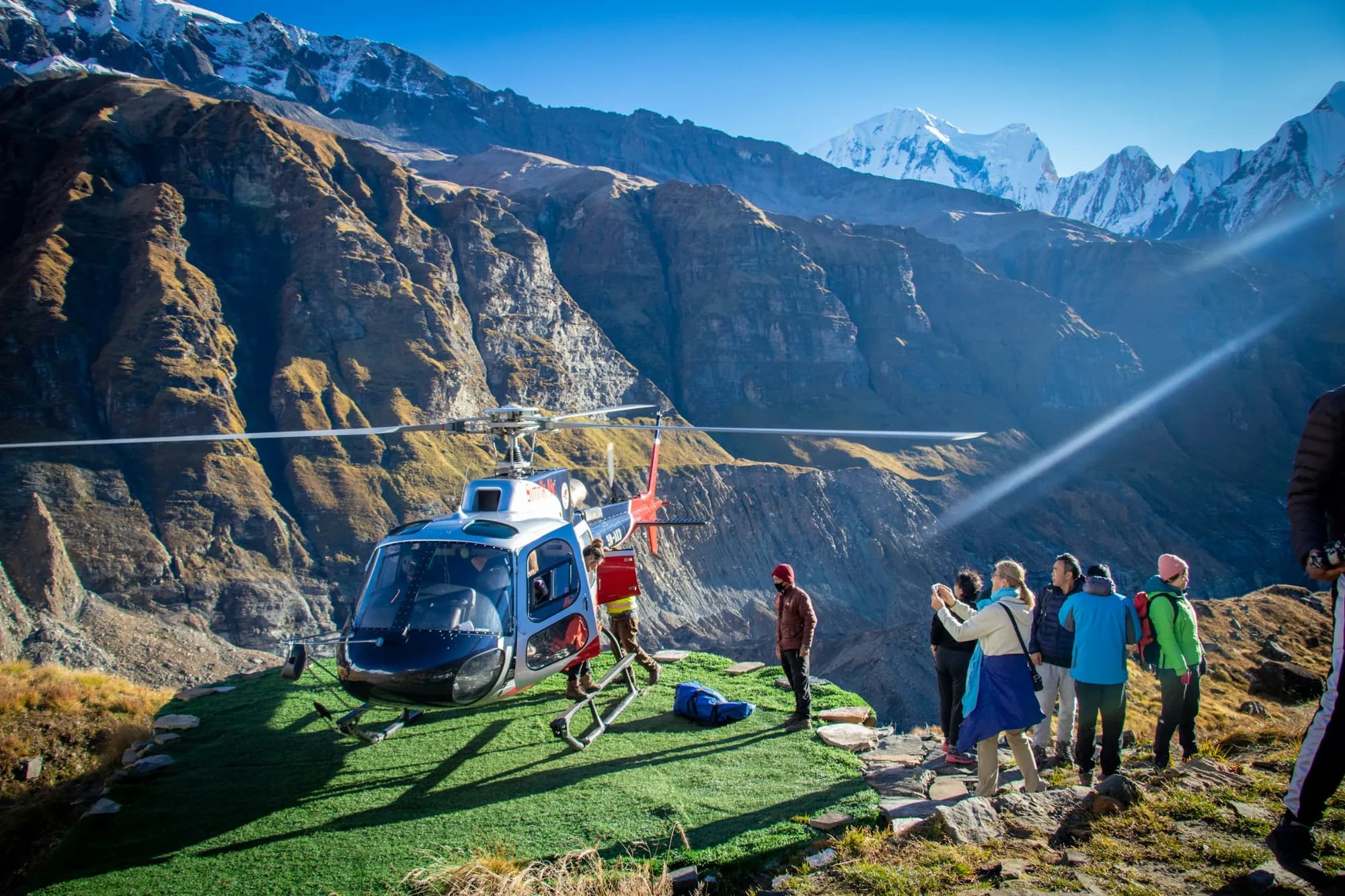
Helicopter evacuation is the single most important line on a Nepal policy. Many trekking routes are hours or days from a road, and the FCDO says a helicopter evacuation usually costs between GBP 1,000 and GBP 2,000 or more per flying hour. The CDC's Yellow Book says helicopter rescue is billed at approximately USD 4,000 per hour, with an average total cost of USD 8,000 to 10,000. Our explainer on how helicopter rescue works in Nepal follows a rescue from the guide's first call to the hospital and covers who pays.
What to check in the policy wording:
- Search, rescue and evacuation are named. The FCDO tells travellers to make sure their insurance includes cover for mountain rescue services and helicopter costs.
- The assistance company is reachable 24 hours, and the client has the number and policy number on paper as well as on their phone. The CDC notes that evacuation policies generally require the rescue to be arranged through the insurance provider.
- Medical justification. Smartraveller notes that insurers have previously declined to pay for evacuations made without proper medical consultation. A good policy and a good operator both expect the decision to be documented: symptoms, the guide's assessment, contact with the assistance company or a doctor, then the flight.
- Repatriation and hospital costs after the helicopter lands in Kathmandu, which can add substantially to the cost of the flight.
Why insurers are cautious about Nepal
Nepal has a history of fraudulent rescue claims. The scheme came to light in 2018, after which the tourism ministry formed an investigation committee, and in March 2026 the Kathmandu Post reported that 32 people had been charged at the Kathmandu District Court, in a scheme involving claims of more than USD 19.6 million. In April 2026 the government announced a zero-tolerance policy and plans for a technology-based rescue management system integrating trekker registration, rescue requests and insurance validation; these were announced as plans, and we found no report by the date checked that the system is in operation. The CDC notes that some evacuation insurers no longer cover Nepal and others add a surcharge.
For agents, the effect is that insurers scrutinise Nepal claims closely. Clients should expect to be asked for medical evidence, and they should never accept a helicopter pushed on them for a minor complaint.
Operator tip: Ask clients to send the policy schedule and the activity and altitude clauses, not only the certificate. The certificate rarely shows the altitude ceiling, and that clause is a common reason for a Nepal claim to fail.
Flights are also a frequent cause of itinerary changes. Our guide to Ramechhap and Lukla flights explains why weather delays happen and how they interact with trip disruption cover.
Peaks and expeditions: extra cover
A trekking peak such as Island Peak or Mera Peak involves ropes, crampons and glacier travel, and many travel policies classify it as mountaineering. A client who is covered for trekking to 6,000 m may still be uninsured on a summit day. Ask for written confirmation that the policy covers mountaineering with ropes and fixed lines to the summit height.
Nepali rules already require insurance for local staff on climbs. Under the January 2025 amendment reported by the Kathmandu Post, minimum cover rose to NPR 2 million for high-altitude guides and NPR 1.5 million for base camp workers. For NMA-listed peaks, The Himalayan Times reported in February 2025 that guides need accident insurance to obtain climbing permits, and B360 Nepal reported in September 2025 that, under its accident insurance scheme for member guides, the NMA will not entertain bills or reports for rescue operations conducted without prior approval. These requirements cover the guides and staff, not your client. The Tourism Bill text passed by the National Assembly in February 2026 would require agencies to arrange personal accident, medical treatment, and search and rescue insurance for expedition members as well as staff, but as noted above it was not yet law when we checked.
Our guide to mountaineering in Nepal covers expedition permits, seasons and logistics in more detail.
| Activity | Who must be insured under current Nepali rules | What the client's policy needs |
|---|---|---|
| Trek on a listed route | No insurance rule found for trekkers | Trekking to the itinerary's altitude, helicopter evacuation, medical, repatriation |
| Trek in a restricted area | Agency responsible for rescue (March 2026 solo-trekker rules) | As above, with remote-area evacuation confirmed |
| Trekking peak (NMA) | Guides need accident insurance before permits | Mountaineering with ropes to the summit height, plus the above |
| Expedition peak | High-altitude guides and base camp workers, at amounts set by the government | Specialist expedition cover, including search and rescue at altitude |
What proof we ask for before departure
We ask agents to send insurance details well before arrival, together with the passport details we use for permits. For every traveller we need:
- Policy schedule showing the insurer, policy number, cover dates and the traveller's name as in the passport.
- Activity and altitude clauses confirming trekking, or mountaineering for peaks, to at least the itinerary's high point.
- Helicopter evacuation and rescue named in the cover.
- 24-hour assistance number and any pre-authorisation process the insurer requires before an evacuation.
- Emergency contact at home, with a phone number.
We hold these with the trek file so that, if an evacuation is needed, the guide and our office can contact the assistance company immediately. Where permits are issued through us, such as the TIMS card or a restricted area permit, we collect the insurance details at the same time. Clients on routes covered by the mandatory trekking guide rule will be with a licensed guide, who carries the details on the trail.
For travel agents: how to package it
What to include
- An insurance clause in your booking conditions requiring cover for the itinerary's activities, maximum altitude and helicopter evacuation.
- A one-page checklist for clients, using the five proof items above.
- The altitude of the trip's high point printed in the itinerary, so clients can match it to their policy.
Buffers and timing
- Ask for policy documents at the deposit stage, so a client who needs an upgrade has time to buy one.
- Check that cover dates include any spare days and the flight home, not only the trek.
Who it suits
- Every client on a trek, peak or remote tour; for city and heritage tours, standard travel insurance with medical cover is usually enough.
- Groups, where one uninsured traveller can hold up an evacuation decision for the whole party.
Upsells
- A trekking peak add-on, such as Island Peak after the Everest Base Camp trek, sold with a clear note that mountaineering cover is needed.
- An extra acclimatisation day, which lowers the risk of a claim in the first place.
If you would like help turning this checklist into a client handout, or want a policy read against a planned itinerary, our operations desk can help. To work with us on a regular basis, become a partner.
Frequently asked questions
Is travel insurance mandatory for trekking in Nepal?
We found no Nepali rule that requires foreign trekkers to hold insurance, and the TIMS process does not ask for it. In practice it is essential: we make it a booking condition, and we suggest agents do the same.
What altitude should insurance cover for Everest Base Camp?
Cover to at least 6,000 m. The trek's high point is usually Kala Patthar, which the Nepal Tourism Board lists at 5,545 m; published figures vary, so a margin avoids any argument.
Does insurance cover helicopter rescue in Nepal?
Only if the policy names it. Check that search, rescue and helicopter evacuation are included, and that the client knows the insurer's pre-authorisation process, as insurers have refused claims for evacuations made without proper medical consultation.
Is a trekking peak covered by trekking insurance?
Often not. Peaks such as Island Peak or Mera Peak involve ropes and glacier travel, which many policies class as mountaineering, so ask for written confirmation of climbing cover to the summit height.
What insurance documents should clients send?
The policy schedule, the activity and altitude clauses, confirmation of helicopter evacuation cover, the 24-hour assistance number and an emergency contact at home.
Sources
- Nepal Tourism Board: TIMS Card
- GOV.UK: Nepal health advice (FCDO)
- GOV.UK: Nepal safety and security (FCDO)
- US State Department: Nepal country information
- Smartraveller: Nepal
- CDC Yellow Book: Nepal
- The Kathmandu Post: Nepal charges 32 in fake rescue scam, 23 March 2026
- The Kathmandu Post: Lawmakers seek tougher Everest climbing rules with 263 amendments to Tourism Bill, 22 July 2026