Island Peak climbing: what operators need to plan for Imja Tse
Island Peak (Imja Tse, 6,160 m on the NMA list) is a glaciated NMA peak in the Khumbu with ladder crossings, a fixed rope headwall and an exposed summit ridge. Plan it after an EBC or Gokyo trek with a contingency day, an NMA permit (USD 350 royalty in spring, USD 175 in other seasons as checked on 16 November 2026) and an NMA registered guide.
| Summit height | 6,160 m on the NMA peaks list (NMA fee page shows 6,165 m)Source: Nepal Mountaineering Association, NMA peaks list (checked 16 Nov 2026) |
|---|---|
| NMA royalty, spring (March to May) | USD 350 per foreign climberSource: NMA service charges for foreign climbers (checked 16 Nov 2026) |
| NMA royalty, autumn, winter, summer | USD 175 per foreign climberSource: NMA service charges for foreign climbers (checked 16 Nov 2026) |
| Guide rule | Every permit holder must be accompanied by an NMA registered sirdar or guide; party size capped at 12Source: NMA rules and guidelines (checked 16 Nov 2026) |
| Sagarmatha National Park entry | NPR 3,000 foreigners, NPR 1,500 SAARC nationalsSource: DNPWC Sagarmatha National Park brochure (checked 16 Nov 2026) |
| Khumbu Pasang Lhamu Trek Card | NPR 3,000 other countries, NPR 2,000 SAARC and ChinaSource: Khumbu Pasang Lhamu Rural Municipality, Trek Card (checked 16 Nov 2026) |
| Fixed ropes | Pangboche Ama Dablam Youth Club fixed rope from crampon point to summit under an NMA agreement from 1 March 2025; confirm the arrangement each seasonSource: The Himalayan Times, 9 March 2025 (checked 12 Nov 2026) |
Island Peak climbing is a popular choice for a first Himalayan summit. Known officially as Imja Tse, it sits above Chhukung in the upper Imja valley of the Khumbu, and it rewards a client who has trekked well with a real glacier climb, a fixed rope headwall and a summit ridge facing Lhotse. It is also easy to sell badly: too few acclimatisation days, no contingency, and clients who meet crampons for the first time at the crampon point. This guide sets out what an operator needs to plan: the route, the technical grade, acclimatisation options, the NMA permit and other fees as checked today, gear, guide ratios and how to package the climb for your market.
Island Peak in brief
Island Peak is one of the 27 peaks administered by the Nepal Mountaineering Association (NMA). The NMA peaks list names it "Imja Tse (Island Peak)" in the Khumbu Himal, Solukhumbu district, and gives the approach as Kathmandu, Lukla, Namche, Tengboche, Pangboche, Dingboche, Chhukung and base camp. That is the classic line, and it is the one most itineraries follow.
On altitude, quote with care. The NMA peaks list gives 6,160 m, while the NMA fee schedule for foreign climbers lists the same peak at 6,165 m. Older guidebooks and some operators still print 6,189 m. We use 6,160 m in client documents because it is the figure on NMA's own peak register, and we suggest you note that published heights differ so a client comparing brochures is not confused.
| Item | Planning detail |
|---|---|
| Official name | Imja Tse (Island Peak), NMA peak |
| Summit height | 6,160 m on the NMA peaks list (6,165 m on the NMA fee page) |
| Region | Khumbu Himal, Solukhumbu, inside Sagarmatha National Park |
| Access | Flight to Lukla, then trek via Namche, Dingboche and Chhukung |
| Typical programme length | About 15 to 19 days Kathmandu to Kathmandu, depending on the acclimatisation route |
| Summit day | Commonly 10 to 12 hours return from base camp, longer for slower groups |
| Main seasons | Spring (March to May) and autumn (September to November) |
| Group cap | NMA rules cap a permitted party at 12 persons |
For context on how NMA peaks sit alongside expedition peaks run by the Department of Tourism, see our guide to mountaineering in Nepal.
Acclimatisation routes: EBC, Gokyo or straight to Chhukung
The single biggest factor in summit success on Island Peak is how well the client has acclimatised before base camp. There are three common shapes, and the right one depends on the client's time and goals.
Via Everest Base Camp
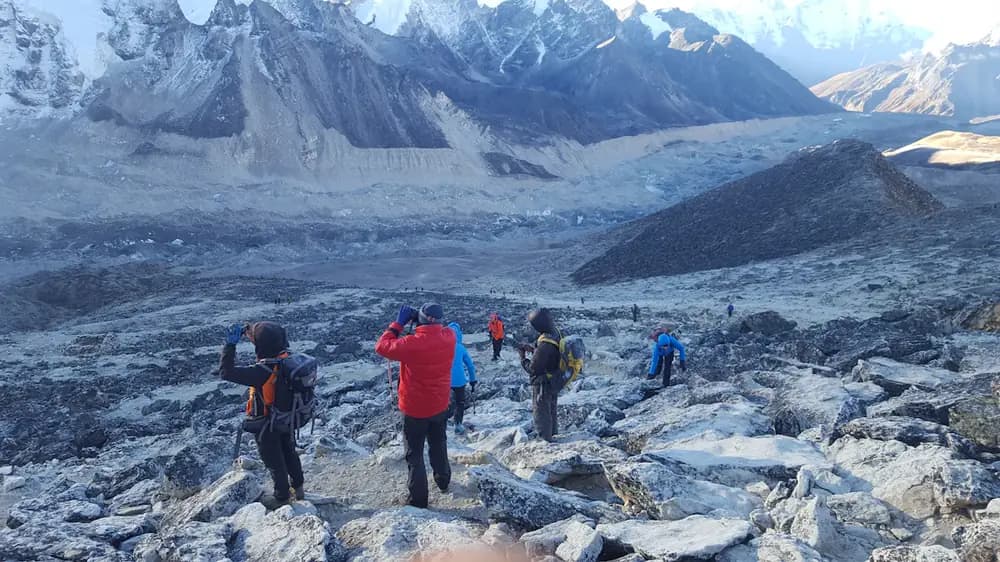
This is the most popular and, for most clients, the best option. The group treks to Everest Base Camp and Kala Patthar, then crosses the Kongma La from Lobuche to Chhukung, or returns down valley to Dingboche and walks up to Chhukung. By the time they reach Island Peak base camp they have slept high for well over a week and have stood higher than base camp already. It also sells well: the client gets EBC and a summit in one trip.
Via Gokyo and the Cho La
For repeat Khumbu visitors, a Gokyo lakes loop with the Cho La crossing to the Everest side, then on to Chhukung, gives a quieter and more varied acclimatisation. It adds days and a demanding glaciated pass, so it suits fit, experienced trekkers rather than first timers. If you want all three passes, Kongma La included, build in extra contingency.
Direct via Dingboche and Chhukung
The shortest version goes Lukla, Namche, Tengboche, Dingboche, Chhukung and base camp. It works only with proper rest days: two nights in Namche, two in Dingboche and at least one acclimatisation hike from Chhukung, ideally a climb of Chhukung Ri. We will not plan a direct itinerary without them. Clients who arrive already acclimatised from a recent high trip can sometimes do this well; clients flying in from sea level often struggle.
A typical day plan for the climb itself
- Chhukung: rest, gear check and a skills session on fixed lines, ascenders, abseiling and ladder crossing, usually led by the climbing guide.
- Chhukung to base camp: a short walk up the moraine to the camp below the peak, with an afternoon of rest and kit preparation.
- Optional high camp: some programmes move to a high camp on the rocky ridge above base camp to shorten summit day. Water is scarce there and the camp is small, so some groups climb from base camp instead.
- Summit day: an alpine start, typically between midnight and 2 am from base camp, summit by late morning, and back to base camp in the afternoon.
- Contingency day: held at base camp or Chhukung for weather, illness or a second attempt.
- Descent: out via Dingboche and Pangboche to Namche and Lukla, usually three days.
Our article on designing itineraries around altitude sickness explains the sleeping altitude gains we work to and how to brief clients on symptoms.
Technical sections: what the client will actually climb
Island Peak is often described as a trekking peak, and that label undersells it. Clients do not need prior Himalayan summits, but they must be comfortable on a glacier, wearing crampons and moving on fixed ropes at altitude, in the dark and in the cold. The route breaks down into four sections.
- Rock and moraine to crampon point: a long, steepening trail and then a rocky gully above the high camp area. It is scrambly in places and tiring at altitude, but not technical. Headtorch, poles and steady pacing matter more than skill here.
- The glacier and crevasses: from crampon point the team ropes up and crosses the glacier, which has crevasses that change every season. Aluminium ladders are commonly placed across the larger gaps, and the bergschrund at the foot of the headwall usually needs a ladder or a short step. Clients must be confident clipping in and walking a ladder in crampons.
- The headwall and fixed ropes: a steep snow and ice slope, often around 45 degrees and steeper in short steps, climbed on fixed lines with a jumar (ascender) and safety lanyard. This is the crux for most clients and where slow movers lose time. Under an agreement with NMA that took effect on 1 March 2025, the Pangboche Ama Dablam Youth Club fixed the route from crampon point to the summit, according to a Himalayan Times report. Confirm with us who holds the rope fixing role for your season.
- The summit ridge: a narrow, exposed snow ridge to a small summit, roped and clipped to fixed lines. Descent of the headwall is by abseil or arm wrap on the fixed ropes, and this is where tired clients make mistakes, so guides keep close.
Conditions vary a lot by season. Late autumn can bring hard, icy snow on the headwall and wider open crevasses; spring often has more snow cover but warmer afternoons and softer descents. Your guide team will judge the turnaround time on the day, and clients should know in advance that the turnaround is not negotiable.
Operator tip: Ask every client for a short climbing CV at booking: any glacier or crampon days, any peaks over 4,000 m, and recent fitness training. If the answer is "none", sell them a pre-trip winter skills course at home or add a full training day in Chhukung, and tell them plainly that the headwall is the crux and a common turnaround point.
Permit and rules: NMA royalty, park and local fees
All fees below were checked on 16 November 2026 against the sources named. Government and local fees can change at the start of a Nepali fiscal year in mid July or with an NMA board decision, so confirm current fees with us before quoting a final price.
NMA climbing permit and royalty
Island Peak needs an NMA climbing permit, issued in Kathmandu through a licensed agency. On the NMA schedule of charges for foreign climbers, Imja Tse sits in the standard tier with most NMA peaks; only Chulu East and Singu Chuli are charged more.
| Season (NMA definition) | Royalty per foreign climber |
|---|---|
| Spring: March to May | USD 350 |
| Autumn: September to November | USD 175 |
| Winter: December to February | USD 175 |
| Summer: June to August | USD 175 |
The practical effect for agents is that a spring summit costs twice the royalty of an autumn summit, so check with us which season's royalty applies before quoting a programme that starts in one NMA season and climbs in the next.
Under the NMA climbing rules, the permit covers one month counted as time spent above base camp, with an extension of up to two weeks possible at an extra 25 percent of the initial fee per week. Each party must nominate a Kathmandu representative, which in practice is the agency, and fees already paid are not refunded if the climb is cancelled.
Garbage deposit and insurance documents
NMA's permit document checklist requires a bank voucher for the permit fee and a garbage deposit, paid together. For a garbage transfer, NMA asks for a request letter from the agency, the original NMA garbage deposit receipt and a clearance letter from the Sagarmatha Pollution Control Committee (SPCC) or other authorised people, so your ground team must bring waste down and get it signed off. NMA does not publish the deposit amount on that page; we confirm it at the time of booking. The same checklist lists accident insurance of NPR 20 lakh, medical insurance of NPR 4 lakh and helicopter rescue cover of USD 10,000. Under the 2025 rope fixing arrangement, the club checks NMA permits on the mountain, and climbing can be cancelled if guides are not insured or foreign climbers do not hold a valid permit.
Sagarmatha National Park and Khumbu local fee
- Sagarmatha National Park entry: NPR 3,000 per foreign visitor and NPR 1,500 for SAARC nationals, per the DNPWC Sagarmatha National Park brochure, collected at the park counter.
- Khumbu Pasang Lhamu Rural Municipality Trek Card: NPR 3,000 for visitors from other countries and NPR 2,000 for visitors from SAARC countries and China, according to the municipality's Trek Card page, available from the tourist information centre in Lukla.
The DNPWC brochure is undated and local fees can change with each fiscal year, so confirm the park and municipality counter fees with us before quoting.
Mandatory guide rule and pending law
NMA rules say every climbing permit holder must be accompanied by an NMA registered sirdar or guide, employed for the whole trek. For the trekking part of the programme, our note on the mandatory trekking guide rule explains what applies on the trail.
Agents also ask about the Integrated Tourism Bill. As the Kathmandu Post reported on 22 July 2026, the bill was entering clause by clause review in a parliamentary committee with 263 proposed amendments, including mandatory licensed guides on designated high risk, protected, Himalayan and remote trekking routes and prior 6,000 m and 7,000 m ascents before 8,000 m permits. None of these proposals had legal effect at the time of that report. In late August 2026 the bill was still before the International Relations and Tourism Committee of the House of Representatives, and we found no report of it passing by 16 November 2026. If they pass, Island Peak may become a formal stepping stone for clients with bigger goals, so it is worth watching. Our Everest permit and royalty note covers the expedition side.
Gear and guide ratios
Technical and personal gear
Most clients hire some technical kit in Kathmandu or Namche, but serious climbers bring their own boots and harness. Fit matters more than brand.
- Mountaineering boots rated for 6,000 m, with crampons that fit them (test the fit in Kathmandu, not at crampon point)
- Climbing harness, helmet, ice axe, jumar (ascender), figure of eight or belay device, two locking karabiners and a cow's tail safety lanyard
- Down jacket, insulated mitts plus liner gloves, warm hat, buff, glacier glasses and a spare headtorch battery
- Sleeping bag suitable for well below freezing at base camp
- Thermos, high energy food and at least two litres of fluid for summit day
Group equipment such as fixed rope, snow stakes, tents, kitchen kit, radios and supplementary oxygen for emergencies is the operator's responsibility. Agree in your contract what the ground handler supplies.
Guide ratios
NMA requires a registered guide with the party, but it does not set a client to guide ratio for summit day. On Island Peak we plan one climbing guide for every two clients on summit day as a minimum, and one to one for less experienced or slower clients, or where a client may need to turn around alone. A trekking guide stays with the group throughout, porters carry to base camp, and a cook team runs base camp. Keep a guide free to descend with a client who turns around without ending the climb for everyone else.
Insurance must cover climbing to above 6,000 m and helicopter evacuation. Many standard trekking policies stop well below that. See our guide to trekking insurance requirements before you confirm a booking.
For travel agents: how to package it
Island Peak sells best as an add on to an Everest region trek rather than as a stand alone climb. Here is how we suggest building it.
- What to include: NMA permit and royalty, Sagarmatha National Park and Khumbu municipality fees, licensed trekking guide and NMA registered climbing guides at a fixed ratio, porters, base camp kitchen and tents, group climbing equipment, garbage deposit handling, guide and porter insurance, and Kathmandu hotel nights either side.
- Buffers: build at least one summit contingency day at base camp or Chhukung, and one or two spare days in Kathmandu at the end. Flights to Lukla are weather dependent and in recent peak seasons many have operated from Ramechhap rather than Kathmandu; our guide to Ramechhap airport and Lukla flights explains the road transfer and timing.
- Who it suits: fit trekkers with some prior altitude, ideally a 4,000 to 5,000 m trek already, and some glacier or winter skills. It is a strong first step for clients planning bigger Himalayan objectives; for a less technical but longer and more remote glacier peak, compare Mera Peak.
- Who it does not suit: clients with no prior altitude and only two weeks, or anyone who is uneasy on exposed ground or ladders.
- Season choice: autumn has lower royalty and generally settled weather; spring has double the royalty but suits groups combining the climb with spring Everest base camp atmosphere.
- Upsells: a private climbing guide at one to one, an EBC and Kala Patthar extension or three passes route, Lobuche East as a second peak, upgraded lodges in Namche and Lukla, and a helicopter return from the Khumbu on request.
Write the summit as an objective, not a promise, in your sales material. Clients who understand that weather and the headwall decide the day are much easier to manage if a turnaround happens. For our full range of peaks, see our climbing and expedition programmes.
How we can help
We are licensed by the Government of Nepal for travel, tour, trekking and mountaineering, and we are a member of NMA and a TAAN member. We use our own guides, transport and hotel contracts, and we handle everything from FIT climbers to large groups, at standard to luxury level. Guides in any language can be arranged on request with advance notice. We obtain the NMA permit, pay park and local fees, arrange the garbage deposit and clearance, and set the guide ratio to suit your clients.
If you want an Island Peak programme under your own brand, talk to us about a partnership.
Frequently asked questions
How hard is Island Peak?
It is a glaciated climb with ladder crossings, a steep fixed rope headwall and an exposed summit ridge at over 6,000 m. Summit day commonly takes 10 to 12 hours, and the altitude and headwall are harder than most trekkers expect.
Do you need climbing experience to climb Island Peak?
No prior Himalayan summit is required, but clients should be fit, have some prior altitude and ideally have used crampons and an ice axe before. Most programmes include a skills session at Chhukung, which helps but is not a substitute for experience.
What permit is needed for Island Peak?
An NMA climbing permit for Imja Tse, issued through a licensed agency in Kathmandu, plus Sagarmatha National Park entry and the Khumbu Pasang Lhamu Rural Municipality fee. NMA also requires an NMA registered guide with the party and a garbage deposit.
What is the best acclimatisation route for Island Peak?
For most clients, trekking to Everest Base Camp and Kala Patthar first, then crossing to Chhukung, gives the best acclimatisation. A Gokyo and Cho La route works for experienced trekkers, and a direct route via Dingboche needs extra rest days.
Which height should we quote for Island Peak?
NMA's peaks list gives 6,160 m and its fee page shows 6,165 m, while some older sources print 6,189 m. We use the NMA peaks list figure and note that published heights differ.
Sources
- NMA: service charges for foreign climbers per person (USD)
- NMA: NMA peaks list
- NMA: rules and guidelines
- NMA: documents required to issue permit
- DNPWC: Sagarmatha National Park brochure
- Khumbu Pasang Lhamu Rural Municipality: Trek Card
- The Himalayan Times: Ama Dablam Youth Club fixing route on Island and Lobuche peaks
- The Kathmandu Post: Lawmakers seek tougher Everest climbing rules with 263 amendments to tourism bill