Lobuche Peak climbing: planning Lobuche East from the Everest Base Camp trail
Lobuche East (6,119 m on NMA's fee schedule) is an NMA peak directly above the EBC trail, with rock, snow and ice on fixed lines up the south east ridge and a summit ridge where some teams stop at the eastern point. Plan it after EBC and Kala Patthar with a contingency day, an NMA registered guide and an NMA permit (USD 350 in spring, USD 175 in other seasons as checked on 17 November 2026).
| Summit height | 6,119 m on the NMA fee scheduleSource: Nepal Mountaineering Association fee schedule (checked 17 Nov 2026) |
|---|---|
| NMA royalty, spring (March to May) | USD 350 per foreign climberSource: NMA service charges for foreign climbers (checked 17 Nov 2026) |
| NMA royalty, autumn, winter, summer | USD 175 per foreign climberSource: NMA service charges for foreign climbers (checked 17 Nov 2026) |
| Guide rule and party size | Every individual or party must be accompanied by an NMA registered guide or sirdar; rules cap a party at 12Source: NMA climbing rules (checked 17 Nov 2026) |
| Sagarmatha National Park entry | NPR 3,000 foreigners, NPR 1,500 SAARC nationalsSource: DNPWC Sagarmatha National Park brochure (checked 17 Nov 2026) |
| Khumbu Pasang Lhamu Trek Card | NPR 3,000 other countries, NPR 2,000 SAARC and ChinaSource: Khumbu Pasang Lhamu Rural Municipality, Trek Card (checked 17 Nov 2026) |
| Fixed ropes | Pangboche Ama Dablam Youth Club fixes rope from crampon point to summit under an NMA agreement from 1 March 2025 (reported March 2025; confirm the arrangement each season)Source: The Himalayan Times, 9 March 2025 (checked 17 Nov 2026) |
| Lobuche West | Listed by NMA as Lobuje West, 6,135 m, same royalty as Lobuche EastSource: NMA fee schedule (checked 17 Nov 2026) |
Lobuche peak, or more precisely Lobuche East, is the climb many Everest Base Camp clients look up at from the lodges at Lobuche and start asking about. It sits directly on the EBC trail, its NMA permit costs the same as Island Peak, and it gives a client a real Himalayan summit day without a separate approach valley. It is also easy to sell badly: the upper route is harder than many brochures suggest, the point some teams reach is not the highest on the mountain, and the naming of the Lobuche summits confuses clients. This guide covers which Lobuche is which, the route and grade, combining the climb with EBC, permits and government fees as checked on 17 November 2026, who it suits and how to package it.
Lobuche East in brief
Lobuche East is one of the peaks for which the Nepal Mountaineering Association (NMA) issues climbing permits under authority from the Government of Nepal. The NMA fee schedule for foreign climbers lists it as "Lobuje East" at 6,119 m. Other published heights for the peak differ slightly, so we use the NMA figure and add a line in client documents that published heights vary.
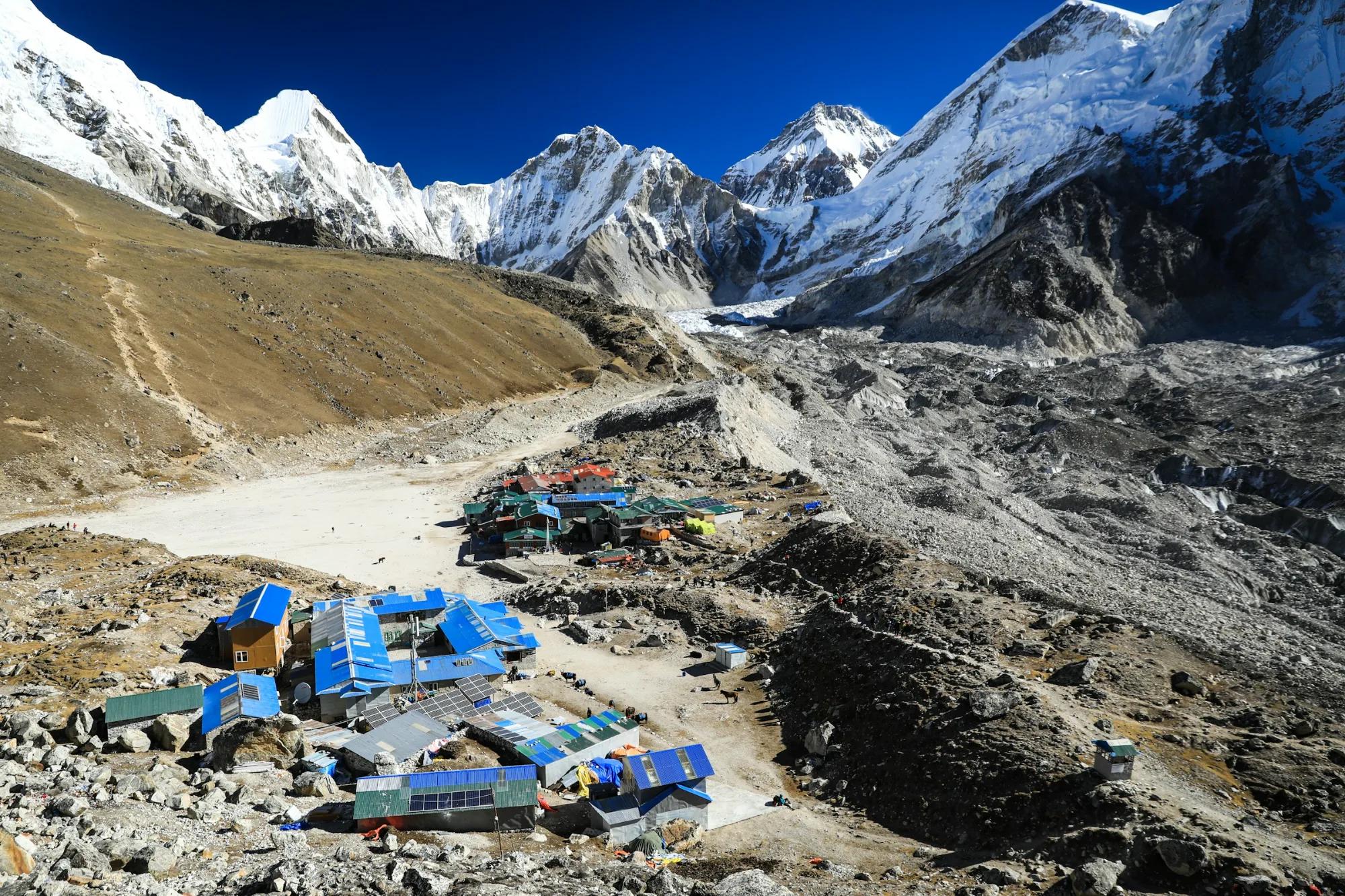
The peak rises directly above the small settlement of Lobuche, on the main trail to Gorak Shep. That is its commercial strength: the climb fits around an EBC trek with no detour, and the descent joins the standard trail out through Pangboche and Namche. For how NMA peaks such as Lobuche differ from the expedition peaks permitted by the Department of Tourism, see our explainer on trekking peaks vs expedition peaks and the permit categories.
| Item | Planning detail |
|---|---|
| Official name | Lobuje East (NMA spelling), sold as Lobuche East or Lobuche Peak |
| Summit height | 6,119 m on the NMA fee schedule |
| Region | Khumbu, inside Sagarmatha National Park (park entry applies) |
| Access | Flight to Lukla, then the EBC trail via Namche, Dingboche and Lobuche |
| Camps | Base camp below the peak near Lobuche, high camp on a rock ledge above (about 4,800 m and 5,400 m in Adventure Consultants' 2026 trip notes) |
| Summit day | Alpine start from high camp; Adventure Consultants plan 6 to 8 hours of climbing to the top before descending to base camp |
| Main seasons | Spring (March to May) and autumn (September to November), as defined on the NMA fee schedule |
| Party size | NMA climbing rules cap a party at 12 |
Lobuche East, Lobuche Far East and Lobuche West
- Lobuche East is the peak sold commercially and the one this guide covers. Its summit ridge has a lower eastern point and the true summit slightly further along. According to Explorersweb, reaching the true summit from the lower point involves some downclimbing, often by abseil, and then following the ridge.
- Lobuche Far East is a name sometimes used for that eastern point on the ridge. Some commercial teams finish there: Adventure Consultants' 2026 Lobuche East trip notes describe their objective as the far eastern summit on the summit ridge, a subsidiary of the high peak. It is not a separate permit or a separate mountain.
- Lobuche West is a separate summit to the west. The NMA fee schedule, checked today, lists "Lobuje West" at 6,135 m with the same royalty as Lobuche East. In Explorersweb's view Lobuche East is easier than the western summit. In our view, West is not a first peak for most clients.
The practical point: state in writing which summit point the programme targets, or a client who later learns they "did not reach the true summit" may feel misled.
Route and difficulty
Lobuche East is often called a trekking peak, and the label undersells it. NMA publishes no technical grades. Adventure Consultants describe the south east ridge as a mixture of rock, snow and ice climbing on fixed rope, with an ascender on the way up and abseiling on the way down; Explorersweb describes the route as mainly on snow, with some steeper sections, and fully fixed. In our operational view it breaks into four sections.
- Base camp to high camp: a climb over the rocky lower flanks to a small high camp on a rock ledge above small lakes, as Adventure Consultants describe it.
- High camp to crampon point: rocky ground climbed in the dark. In our experience slow or nervous clients lose time here.
- Crampon point to the summit ridge: snow and ice on the south east ridge, onto icy slopes near the top. Clients move on fixed lines with an ascender clipped to the harness and descend by abseil.
- Summit ridge: the eastern point and the true summit described above. Going on to the true summit is a guide's call on the day, based on time, conditions and the client's pace.
Adventure Consultants plan a start at around 2:30 am from high camp and 6 to 8 hours to the top. Slower groups take longer, so put the turnaround time in the client briefing.
Fixed ropes and who manages them
Under an agreement with NMA that took effect on 1 March 2025, the Pangboche Ama Dablam Youth Club fixes the route on Lobuche and Island Peak from crampon point to summit, checks NMA permits on the mountain and keeps a record of Nepali guides. The Himalayan Times reported that the club had fixed 800 m of new rope on the two peaks by 7 March 2025, and that it requires trekking companies to insure their guides for accident, medical treatment and helicopter rescue, with climbs cancelled where guides are uninsured or climbers have no valid permit. This arrangement was reported in March 2025; confirm it each season, including whether any rope charge applies.
Lobuche East vs Island Peak
Agents often choose between these two for a first Khumbu summit. In Explorersweb's view Lobuche East is harder than Island Peak or Mera. In our assessment the difficulty sits in different places, and the better choice depends on the client.
| Feature | Lobuche East | Island Peak (Imja Tse) |
|---|---|---|
| Height on the NMA fee schedule | 6,119 m | 6,165 m |
| NMA royalty, foreign climber | USD 350 spring, USD 175 autumn, winter and summer | Same: USD 350 spring, USD 175 other seasons |
| Base camp | Below the peak near Lobuche, on the EBC trail | Above Chhukung in the Imja valley, off the main EBC trail (see our Island Peak guide) |
| Technical features | Rock, then snow and ice on the south east ridge, on fixed lines, with an eastern point and a true summit | A crevassed glacier with ladder crossings and a steep fixed rope headwall (see our Island Peak guide) |
| Fixed ropes | Pangboche Ama Dablam Youth Club under an NMA agreement, reported March 2025; confirm the arrangement each season | Same arrangement, same caveat |
| Fit with an EBC trek | On the trail, no detour | Side valley, adds days |
For the full Island Peak picture, including the headwall and ladder sections, see our Island Peak climbing guide for operators. For a lower, less technical first peak away from the Khumbu, compare our Yala Peak guide for Langtang.
Combining with EBC
Lobuche East sells because it fits around Nepal's most popular trek. Two shapes work well. Climbing before EBC shortens the trip but puts the summit attempt before the client's best acclimatisation, so keep it for clients already acclimatised from a recent high trip.
EBC first, then Lobuche
This is the shape we recommend for most clients. The group follows the standard EBC trail with two nights in Namche and two in Dingboche or Pheriche, continues to Lobuche and Gorak Shep, visits Everest Base Camp and climbs Kala Patthar, then drops back to Lobuche base camp. By the time they move to high camp they have slept high for a week or more and stood higher than high camp already. Adventure Consultants' 2026 post-monsoon programme follows this pattern (via Pheriche, with Kala Patthar) over 20 days Kathmandu to Kathmandu, including a contingency day; their spring version replaces Gorak Shep and Kala Patthar with a night at Everest Base Camp.
Gokyo and the Cho La
For repeat Khumbu visitors, the Gokyo lakes and the Cho La crossing to Dzongla give a quieter and more varied approach that rejoins the trail near Lobuche. It adds days and a glaciated pass, so it suits fit, experienced trekkers.
A typical day plan for the climb
- Lobuche to base camp: a short walk after EBC, kit check, then a skills session on fixed lines, ascender use and abseiling.
- Base camp to high camp: a few hours of climbing and an early night.
- Summit day: an alpine start, the top by late morning in good conditions, and down to base camp in the afternoon.
- Contingency day: held for weather, illness or a second attempt.
- Descent: out via Pangboche and Namche to Lukla, usually three days.
Our article on designing itineraries around altitude sickness explains the sleeping altitude gains we work to. On the flight side, check whether your dates fall when Lukla flights operate from Ramechhap rather than Kathmandu, which adds an early road transfer; our Ramechhap and Lukla flights guide covers the details.
Operator tip: Put the contingency day inside the itinerary you sell, not in the small print, and name the summit point in the trip description ("the east summit of Lobuche East, with the true summit at the guide's discretion"). Those two lines remove the most likely causes of a post-trip dispute.
Permits and government fees
Lobuche East is an NMA peak, so the climbing permit comes from NMA, not from the Department of Tourism; in practice the ground agency handles the application. The figures below were checked on official pages on 17 November 2026.
- NMA climbing permit (royalty): USD 350 per foreign climber in spring (March to May) and USD 175 in autumn (September to November), winter (December to February) and summer (June to August), per the NMA fee schedule.
- Garbage deposit: NMA's permit document checklist requires a Nabil Bank voucher covering the permit fee and the garbage deposit. The page does not state the deposit amount, so confirm the current amount and refund terms with us before quoting.
- Sagarmatha National Park entry: NPR 3,000 for foreigners and NPR 1,500 for SAARC nationals, per the DNPWC Sagarmatha National Park brochure.
- Khumbu Pasang Lhamu Rural Municipality Trek Card: NPR 3,000 for visitors from other countries and NPR 2,000 for visitors from SAARC countries and China, according to the municipality's Trek Card page, issued at the tourist information centre in Lukla.
- Permit validity: NMA's climbing rules grant permission for one month, counted from time spent above base camp, extendable by two weeks at an extra 25 percent of the initial fee per additional week.
- Refunds: the same rules state that fees already paid are not refunded if the permission is cancelled or the climb does not go ahead.
The DNPWC brochure is undated and local fees can change with each fiscal year, so confirm the park and municipality fees with us before quoting.
Guides, insurance and garbage clearance
NMA's rules require every individual or party to be accompanied by a guide or sirdar registered with NMA, employed from the start of the trek to its end, so a solo climb without a registered guide is not an option. The rules do not call for a government liaison officer; instead each party nominates a representative in Kathmandu, an individual or organisation registered with NMA, to liaise with NMA and act in an emergency. In practice that is the ground agency.
The same NMA document checklist lists accident insurance of 20 lakh, medical insurance of 4 lakh and helicopter rescue cover of USD 10,000. For a garbage deposit transfer, NMA asks for the original deposit receipt and a clearance letter from the Sagarmatha Pollution Control Committee (SPCC) or other authorised people, so the ground team must bring waste down and have it signed off.
Client insurance should also cover helicopter evacuation and climbing above 6,000 m; see our Nepal trekking insurance requirements. For the wider expedition picture, see our guide to mountaineering in Nepal.
Who it suits
Lobuche East works best for:
- Fit EBC clients who want a summit too and can add several days to a standard EBC itinerary.
- Repeat Khumbu visitors who have done EBC and want a new goal, ideally approached via Gokyo and the Cho La.
- Clients preparing for bigger objectives; Explorersweb describes Lobuche as a common acclimatisation climb for teams heading to Everest, Lhotse or Ama Dablam. Our Ama Dablam expedition guide covers the next step up.
- Clients who have used crampons, an ice axe and an ascender before, even on a short course at home.
It suits less well:
- Clients uneasy with exposure or with scrambling on rock in the dark.
- Clients with a hard return date who cannot accept a contingency day or a missed summit.
- Complete beginners on a short trip, for whom a skills course first is the better step.
For travel agents: how to package it
Lobuche East sells best as a named add-on to an EBC trek. These are the points we recommend.
What to include
- The NMA permit, the garbage deposit handling, Sagarmatha National Park entry and the Trek Card, each listed as a government or local fee rather than buried in a package price.
- An NMA registered climbing guide. A summit day ratio of no more than two clients per climbing guide is a sensible standard to specify; one to one for clients without crampon experience.
- Base camp and high camp tents, kitchen, cook and porterage.
- A skills session at base camp, and a gear check with hire options for boots, crampons, harness and ascender.
- Lukla flights, with the Ramechhap routing explained where it applies.
- A clear insurance requirement in your booking conditions.
Buffers
- One contingency day on the mountain, sold as part of the itinerary.
- One or two spare days at the end for Lukla flight delays.
- A written turnaround time for summit day, agreed with the guide and shared with the client before departure.
Upsells
- The Gokyo and Cho La approach for repeat visitors, or a night at Everest Base Camp in spring.
- A helicopter return from the upper Khumbu for clients short of time after the climb.
- Private departures and guides in the client's language on request with advance notice.
Write the contract terms around three points: the royalty is not refundable, the summit point is defined, and the guide's decision on the day is final. Clients who understand those three points before they fly have clear expectations of the outcome.
We are licensed by the Government of Nepal for trekking and mountaineering, are members of NMA and a TAAN member, and run our own guides and transport for groups from FIT to large parties. For more climbing options, see our climbing and expedition programmes. If you want Lobuche East priced into an EBC departure for your market, talk to us about a partnership and we will build it around your dates and client profile.
Frequently asked questions
Is Lobuche East harder than Island Peak?
In Explorersweb's view Lobuche East is harder than Island Peak or Mera; its upper route mixes rock, snow and ice on fixed lines, and reaching the true summit involves some downclimbing. Island Peak has its own challenges, so the better choice depends on the client.
Do you need ropes for Lobuche East?
Yes. The upper route is fixed from crampon point to the summit by the Pangboche Ama Dablam Youth Club under an NMA agreement (reported March 2025; confirm the arrangement each season), and clients climb on it with a harness, ascender, crampons and ice axe.
Can Lobuche be combined with EBC?
Yes, and it is the usual way to climb it. The common shape is EBC and Kala Patthar first, then back to Lobuche base camp, high camp and the summit, which gives the best acclimatisation before the climb.
What is the difference between Lobuche East, Lobuche Far East and Lobuche West?
Lobuche East is the commercially climbed peak; Lobuche Far East is a name sometimes used for the eastern point on its summit ridge, where some commercial teams finish short of the true summit. Lobuche West is a separate, more serious summit that NMA also lists, at 6,135 m on its fee schedule.
What permits are needed for Lobuche East?
An NMA climbing permit, usually applied for by the ground agency (USD 350 in spring, USD 175 in other seasons per foreign climber on NMA's fee schedule, checked 17 November 2026), plus a garbage deposit, Sagarmatha National Park entry and the Khumbu Pasang Lhamu Trek Card. NMA also requires a registered guide with the party.
Is a liaison officer required on Lobuche East?
NMA's climbing rules do not call for a government liaison officer. Each party instead nominates a representative in Kathmandu registered with NMA, which in practice is the ground agency.
Sources
- Nepal Mountaineering Association: service charges for foreign climbers
- Nepal Mountaineering Association: climbing rules and guidelines
- Nepal Mountaineering Association: documents required to issue permit
- DNPWC: Sagarmatha National Park brochure
- Khumbu Pasang Lhamu Rural Municipality: Trek Card
- The Himalayan Times: Ama Dablam Youth Club fixing route on Island and Lobuche peaks (9 March 2025)
- Explorersweb: No easy Himalayan trekking peak, a British climber dies on Lobuche (16 November 2022)
- Adventure Consultants: Lobuche East 2026 trip notes