Porters in Nepal: weight limits, welfare and what agents should check
Nepal has no government weight limit for trekking porters. The International Porter Protection Group sets a maximum of 30 kg in Nepal, adjusted for altitude, trail and weather, and KEEP recommends no more than 25 kg including the porter's own gear. Agents should also check that porters get proper kit, shelter and insurance, and are never sent down alone when ill.
| Government load limit (trekking) | None; no official regulations or weighing checkpoints for porter loadsSource: KEEP, quoted in The Kathmandu Post, 12 Dec 2025 (checked 15 Nov 2026) |
|---|---|
| IPPG maximum load in Nepal | 30 kg, adjusted for altitude, trail and weatherSource: International Porter Protection Group guidelines (checked 15 Nov 2026) |
| KEEP recommended load | No more than 25 kg including clients' luggage and the porter's own gear; lighter above 5,000 mSource: The Kathmandu Post, 12 Dec 2025 (checked 15 Nov 2026) |
| Labour Act insurance minimums | Medical Rs 100,000 a year and accident Rs 700,000 per worker (sections 54 and 55)Source: Labour Act 2074 (2017), FAOLEX (checked 15 Nov 2026) |
| Agreed porter wage | Rs 2,400 a day (porter-guide Rs 2,500) from 17 July 2023Source: The Himalayan Times, 21 Jun 2023 (checked 15 Nov 2026) |
| Tara Air free baggage (USD and Indian fares) | 10 kg baggage plus 5 kg hand carrySource: Tara Air baggage policy (checked 15 Nov 2026) |
Porters carry most of the weight on a Nepal trek, and how a ground partner treats them is one of the clearest tests of how it runs everything else. Porter welfare is also a question clients can put to you directly, and the answer should rest on published guidelines rather than reassurance. This guide sets out the load guidelines that exist, what a porter should be given, how insurance and illness should be handled, and the questions to put to any partner before you contract. Every source below was checked on 15 November 2026.
Porter, porter-guide or guide?
Three roles carry loads or lead on a commercial trek in Nepal. They are trained, licensed and paid differently, and a quote should make clear which ones are included.
- Porter. Carries trekkers' duffels between lodges and walks the same stages as the group. A porter is not a guide and should not be sold as one.
- Porter-guide. A porter who has completed guide training and holds a porter-guide licence from the Department of Tourism. In November 2018 Republica reported that the Department of Tourism was beginning to issue porter-guide licences to around 1,500 porter-guides trained by NATHM or the Nepal Mountain Academy. A porter-guide carries a load and helps with the route, which can suit a couple on an easier trail.
- Licensed trekking guide. Leads the group, makes the daily calls on pace, weather and health, and deals with lodges and checkposts. Whether a licensed guide is required on a given route is a separate question; our explainer on the mandatory trekking guide rule covers where the requirement applies.
Daily wages for these roles are agreed within the trekking industry rather than set as a government fee. The Trekking Agencies' Association of Nepal (TAAN) announced the rates below after consultations with trade unions, effective from 17 July 2023, as The Himalayan Times reported. In December 2025 the Kathmandu Post still described Rs 2,400 a day as the TAAN recommended minimum for porters.
| Role (as named in the report) | Agreed daily wage from 17 July 2023 |
|---|---|
| Mountain guide | Rs 3,100 |
| Assistant trekking guide | Rs 2,800 |
| Porter-guide | Rs 2,500 |
| Porter | Rs 2,400 |
Source: The Himalayan Times, 21 June 2023, checked 15 November 2026. These are industry wage rates, not government fees and not trip prices, and they can be revised. Confirm the current rate with us before you build costings around it.
Weight limits: what exists and what does not
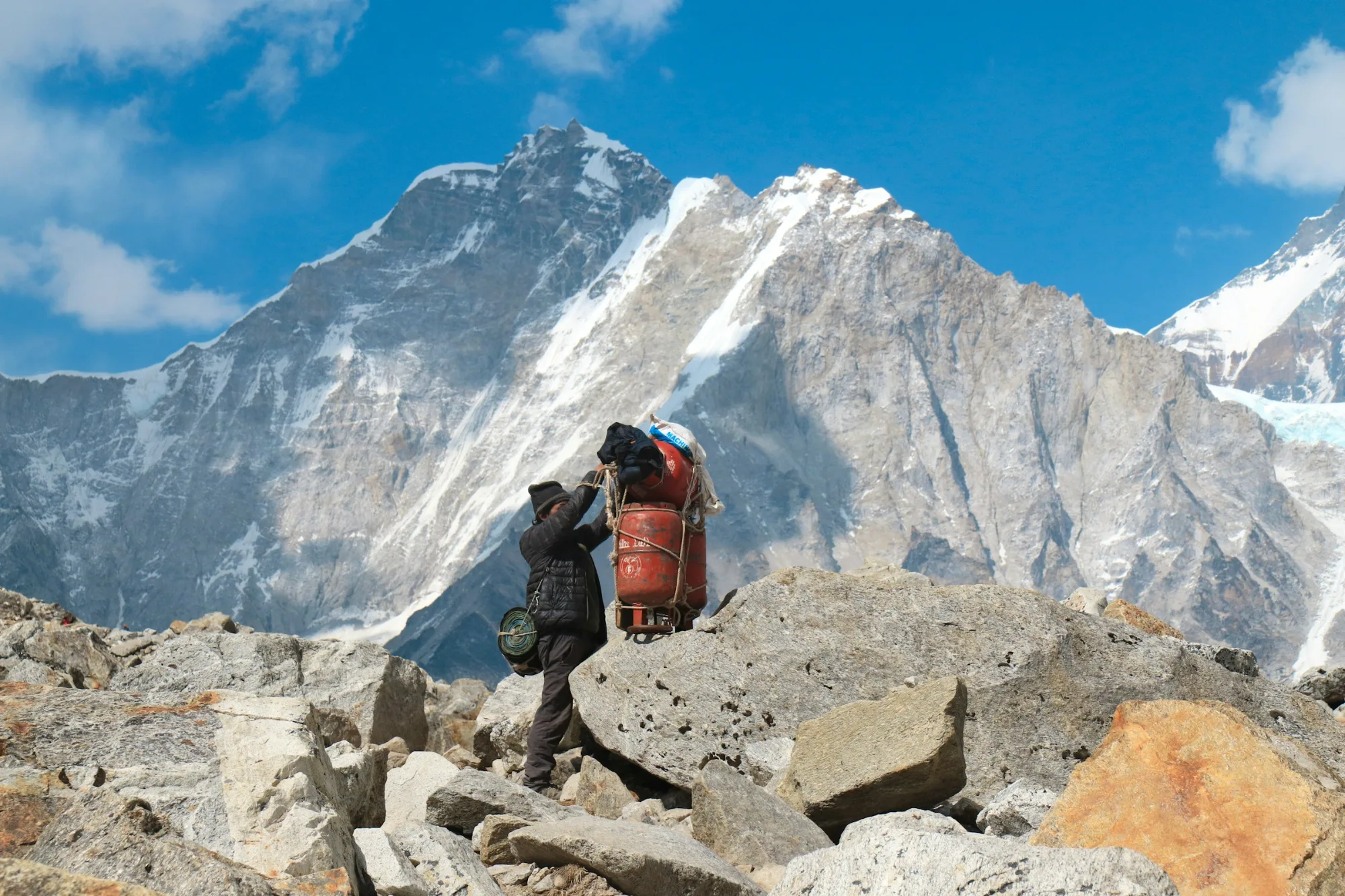
There is no government load limit for trekking porters in Nepal. In December 2025 the Kathmandu Post quoted the Kathmandu Environmental Education Project (KEEP), which runs porter welfare programmes, as saying there are no official government regulations and no checkpoints where porters' bags are weighed. The same article described porters carrying bags of 40 to 60 kg on routes such as the Manaslu and Annapurna circuits. The limits that do exist come from welfare organisations.
| Source | Maximum load | Status |
|---|---|---|
| International Porter Protection Group (IPPG) | 30 kg in Nepal, adjusted for altitude, trail and weather | Welfare guideline |
| KEEP | 25 kg including clients' luggage and the porter's own gear, and lighter above 5,000 m | Welfare recommendation, quoted in the Kathmandu Post, December 2025 |
| Government of Nepal | No official limit and no weighing checkpoints | As stated by KEEP to the Kathmandu Post |
IPPG's wording is worth passing to clients as it stands: no porter should be asked to carry a load that is too heavy for their physical abilities. The 30 kg figure is a ceiling, not a target, and IPPG says weight limits may need to be adjusted for altitude, trail and weather conditions, a judgement that takes experience.
The numbers add up faster than clients expect. Tara Air publishes a free baggage allowance of 10 kg of baggage plus 5 kg of hand carry. Two client duffels at that 10 kg allowance already make 20 kg before the porter's own clothing and sleeping kit is added, which leaves very little room under KEEP's 25 kg. A firm per-client duffel limit, set at or below the flight allowance, is the simplest way to keep loads within the guidelines, and the porter ratio should follow from the total weight rather than from a fixed rule. Our Ramechhap and Lukla flights guide covers the flight side of the same limit.
Load matters for safety as well as comfort. KEEP told the Kathmandu Post that at least two to three trekking porters had died in the mountains in 2025, and linked those deaths to altitude sickness and improper gear. A heavy load at altitude, carried in poor kit, is exactly the combination the welfare guidelines are written to prevent.
Gear, food and shelter
IPPG sets out five guidelines for trekking groups. Two of them cover what a porter is given on the trail.
- Clothing. IPPG says clothing appropriate to season and altitude must be provided to porters for protection from cold, rain and snow. Its suggested list includes a windproof jacket and trousers, fleece jacket, long underwear, suitable footwear (leather boots in snow), socks, hat, gloves and sunglasses.
- Shelter. Above the tree line, IPPG says porters should have a dedicated shelter, either a room in a lodge or a tent, with a sleeping pad and a blanket or sleeping bag. It adds that the trekkers' mess tent does not count, because it is not available until late evening.
- Food. IPPG asks that porters receive food and warm drinks, or cooking equipment and fuel.
The Kathmandu Post reported that KEEP runs a clothing centre in Kathmandu that lends boots, jackets, gloves and other gear to porters or agencies against a deposit, refunded on return less cleaning costs. That helps porters who work for operators that do not issue kit, but it is not a substitute for a partner that equips its own staff. On departures from December to February, cold is the hazard to plan around; read our note on which treks work in winter before selling a high pass in that season.
Insurance, illness and altitude
Porters face the same mountain hazards as clients, often in thinner clothing and poorer shoes, and KEEP notes that many come from the lowlands and are no better adapted to altitude than anyone else. IPPG's third and fourth guidelines deal with this, and Nepal's labour law adds a legal floor.
- Medical care and insurance. IPPG says porters should be provided with the same standard of medical care as you would expect for yourself, and with life insurance. Nepal's Labour Act 2074 (2017) requires employers to buy medical insurance of at least Rs 100,000 a year for each worker, with the premium shared between employer and worker (section 54), and accident insurance of at least Rs 700,000 for each worker, with the premium paid by the employer (section 55). Section 57 says this does not apply to the extent that the worker is covered through a Social Security Fund scheme, so ask which route your partner uses.
- Illness. IPPG says porters should not be paid off for illness or injury without the leader or the trekkers assessing their condition, and that sick or injured porters should never be sent down alone, but with someone who speaks their language and a letter describing the complaint. It also says enough money should be provided to cover rescue and treatment.
The Kathmandu Post article also stated that the travel agency is responsible for providing porters' insurance, along with food and accommodation or the funds to pay for them. That is the standard to hold a ground partner to, whether porters are permanent staff or hired for a single trek.
Mountain medical care matters for staff as much as for clients. The Himalayan Rescue Association's spring 2025 report records 1,380 Nepali and 443 foreign patients, for all conditions, across its Manang and Pheriche aid posts and its Everest ER clinic; Nepali patients, who include local people and trekking staff, outnumbered foreign patients. On altitude illness specifically, The Himalayan Times reported in July 2026, citing ACAP, that 25 people died of altitude sickness in the Annapurna Conservation Area in fiscal year 2025/26; 12 were Nepali, and four of those were trekking guides or porters.
A porter who falls ill high on a trail should get the same response as a client: rest, no further ascent, descent with a companion and evacuation when the condition calls for it. The acclimatisation profile protects porters too, which is one more reason to build it properly; our guide to designing trek itineraries around altitude sickness sets out the ascent rates and rest days. Our article on how helicopter rescue works in Nepal explains the evacuation process, and our guide to Nepal trekking insurance covers the client side.
Operator tip: Before the season, ask your ground partner for two documents: the kit list actually issued to porters, and the insurance policy or Social Security Fund record that covers them. A partner that treats porters well can produce both quickly. A general promise in place of paperwork is an answer in itself.
Porter welfare as part of responsible tourism
Porter welfare sits alongside waste, plastics, group size and local spending in any serious responsible tourism policy, and it is the part clients can see for themselves on the trail. An overloaded porter in thin shoes on a snowy pass is visible to every client in the group. If your company publishes a sustainability or responsible travel statement, porter loads, kit, shelter and insurance should be written into it as concrete standards, and your ground partner should confirm each one in writing.
Our overview of what a responsible ground operator in Nepal can actually do covers the wider list, including which practices are already required by law and which are voluntary. For porters, the practical standards come down to five points: a stated maximum load at or below the IPPG and KEEP guidelines, season-appropriate kit, a dedicated bed above the tree line, insurance that meets the Labour Act, and an illness procedure that never sends a porter down alone.
What to ask before you contract
These questions take ten minutes on a call and show most of what you need to know. Use them alongside our wider checklist on how to choose a Nepal tour operator and the steps to verify TAAN membership.
| Question | A good answer looks like |
|---|---|
| What is the maximum load per porter? | A stated figure at or below the IPPG and KEEP guidelines, a per-client duffel limit, and a rule for reducing loads at altitude. |
| Are porters your own staff or hired on the trail? | A named team, or a clear explanation of how locally hired porters are briefed, equipped and insured. |
| What kit do porters receive? | A written list that matches the season and the highest point of the trek. |
| Where do porters sleep above the tree line? | A room or tent with a mat and a sleeping bag or blanket, booked alongside the client rooms. |
| Are porters insured, and for what? | Accident and medical cover that meets the Labour Act minimums, or Social Security Fund cover, with the document on request. |
| What happens if a porter falls ill? | Assessment by the guide, descent with a companion, and rescue and treatment paid by the operator, never by the porter. |
| What are porters paid? | A rate at or above the agreed industry wage, paid by the operator, with tips treated as extra. |
For travel agents: how to package it
- What to include: a stated duffel weight per client, a porter ratio worked out from that weight, and porter kit, food, lodging and insurance inside the trip price rather than sold as extras.
- Buffers: porters need the same rest and acclimatisation days as clients. Do not cut a rest day to save cost; a compressed itinerary puts the extra strain on the people carrying the loads.
- Who it suits: porters suit most clients on teahouse treks. A porter-guide can work for experienced couples on easier trails. Larger groups and camping treks need a full crew with a licensed guide and assistant guides.
- Upsells: an extra porter for clients who want a lighter daypack or bring camera or climbing kit, and a private porter for clients travelling alone.
- Client communication: put the duffel limit, the porter ratio and your welfare standards in the pre-departure notes, so clients pack to the limit before they reach Kathmandu.
Expert DMC Nepal is licensed by the Government of Nepal for travel, tour, trekking and mountaineering, is a TAAN member and an NMA member, and works with its own guides, transport and hotel contracts. Our operations desk is open Sunday to Friday, 10:00 to 17:30 Nepal time.
Travel agents and tour operators who want these porter standards written into their Nepal programmes can set up a partnership with us here.
Frequently asked questions
How much weight does a porter carry in Nepal?
There is no legal limit for trekking porters. The International Porter Protection Group sets a maximum of 30 kg in Nepal, and KEEP recommends no more than 25 kg including the porter's own gear, with lighter loads above 5,000 m.
Are porters insured?
They should be. IPPG asks for life insurance and the same standard of medical care a trekker would expect, and Nepal's Labour Act 2074 requires employers to arrange accident and medical insurance for each worker unless Social Security Fund cover applies. Ask your ground partner for the document.
What is a porter-guide?
A porter who has completed guide training and holds a porter-guide licence from the Department of Tourism. Porter-guides carry a load and help with the route.
How many porters does a group need?
Work it out from weight: set a duffel limit per client, add the porter's own kit, and keep each load within the IPPG and KEEP guidelines. With duffels at a 10 kg flight allowance, that usually means no more than two clients' bags per porter.
What happens if a porter gets sick on the trail?
The guide should assess the porter, stop any further ascent and arrange descent with a companion who speaks their language, with rescue and treatment paid by the operator.
Sources
- International Porter Protection Group: Trekking ethics and porter guidelines
- The Kathmandu Post: Porters keep tourists moving, but who looks after them?
- The Himalayan Times: Wages of trekking workers increase
- Nepal Labour Act 2074 (2017), FAOLEX
- Republica: Govt issuing license to 1,500 porter-guides
- Himalayan Rescue Association: Brief report of spring season 2025
- The Himalayan Times: 25 tourists die of altitude sickness in Annapurna region in FY 2025/26
- Tara Air: Baggage policy